


Chennai, March 20,2025
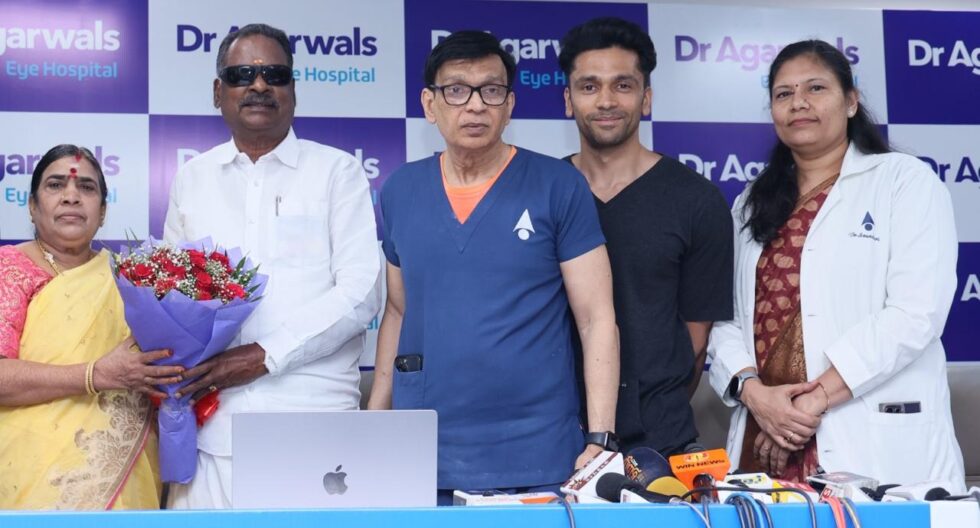
Dr Agarwals Eye Hospital successfully performed a complex surgical intervention that combined pinhole pupilloplasty (PPP) with corneal and scleral repair to restore the vision of a senior citizen who sustained severe injuries in his right eye while playing badminton, a statement from Dr.Aggarwals hospital said.
Addressing a press conference, Prof. Dr. Amar Agarwal, Chairman of Dr. Agarwals Eye Hospital,
said that Mani, 67 years old, suffered a severe injury to his right eye, with complete corneal damage.
He said that following the procedure, the patient completely regained his vision, and the wound is healing well.
In such cases, corneal transplantation would typically be performed, requiring donor cornea from a cadaver.
Dr.Amar Aggarwal said ,“Transplantation typically involves multiple sutures, increasing the risk of infection and long-term complications. However, we opted for a full-thickness repair of the cornea and sclera—the frontal parts of the eye—repositioned the prolapsed intraocular contents, and implanted an artificial lens to treat the pre-existing cataract.“
He said that since patients who undergo corneal tear repair often experience visual deterioration due to high astigmatism and corneal aberrations, the procedure was conducted with Pinhole Pupilloplasty.
He further said, “All these interventions were performed in a single sitting, ensuring a comprehensive and effective solution for vision restoration.”
Dr Ashvin Agarwal, Chief Clinical Officer, Dr Agarwals Eye Hospital, said, “Over 54% of ocular emergencies and 32% of blindness cases in India result from trauma, often leading to corneal scarring, opacities, and astigmatism, which cause vision loss or blurring. “
He said that in severe cases, corneal transplantation is typically performed. However, even after a transplant, vision impairment may persist.
Pinhole Pupilloplasty (PPP) has emerged as a groundbreaking alternative for many patients. It requires no additional equipment, is easy to learn, and significantly reduces surgical costs.
PPP is particularly beneficial for conditions such as corneal scarring and opacities that would otherwise require full-thickness corneal grafting.
Additionally, patients with high astigmatism—such as those with keratoconus, post-pterygium excision, or post-corneal tear repair—can achieve significant improvements in their visual quality through this procedure.
The emergency intervention successfully avoided the need for corneal transplantation, significantly reducing the risks of infections and graft rejection while ensuring a safer and more effective vision restoration.
The integration of Pinhole Pupilloplasty (PPP) with multiple surgical procedures, including intraocular tissue repositioning and artificial lens implantation to address the patient’s pre-existing cataract, is a rare and complex intervention.
Traditionally, PPP has been used primarily for the treatment of high astigmatism. People with conditions like keratoconus, post-pterygium excision, and post-corneal tear repair, can experience significant improvement in their quality of vision following Pinhole Pupilloplasty.