



Thiruvananthapuram, April 2
In a rare confluence of art, devotion and legacy, the consecration of the Adishakti Devi idol at Pournamikkavu is not merely a spiritual milestone—it is also the culmination of generations of craftsmanship shaped by master sculptors and carried forward by Mukesh Bhardwaj, Managing Director of King Moorti Kala Kendra, Jaipur.
The Prana Pratishta of Adishakti Devi was conducted as a grand spiritual ceremony from on April 2 (Pournami day) between 10:30 am and 12 noon, considered an auspicious muhurtham.
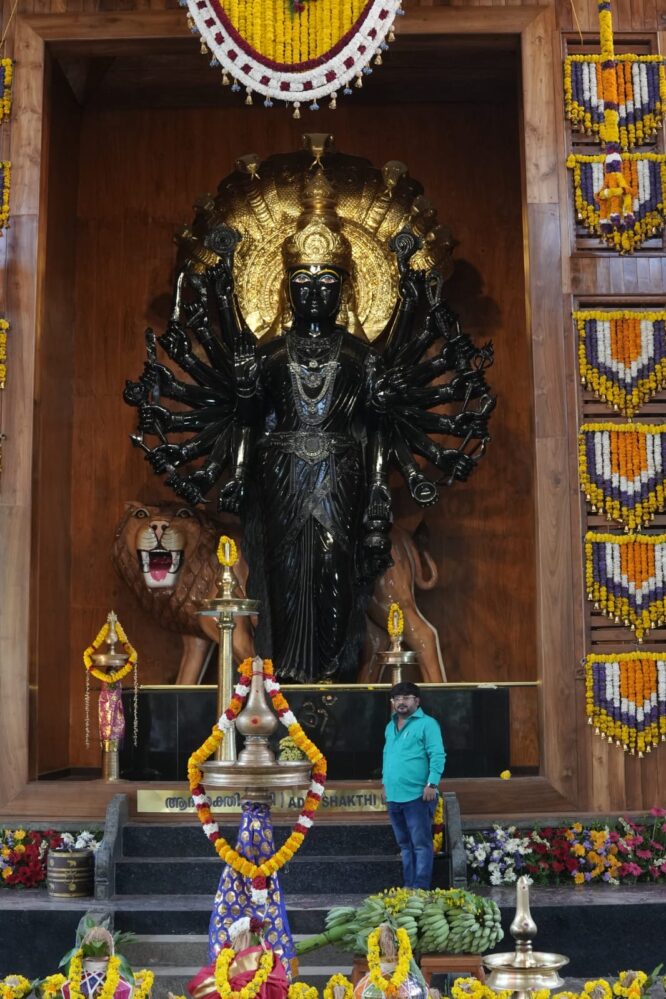
This consecration is believed to be the first of its kind in the world, marking the installation of Adishakti—the primordial cosmic energy that governs the universe.
According to spiritual philosophy, Adishakti is the force behind all motion and existence. Every element in the universe functions through this energy—from the movement of planets to the ability of humans to speak, remember, see and even digest food.
Even those who do not subscribe to traditional belief systems often acknowledge the presence of a supreme force that governs the cosmos—this universal energy is revered here as Adishakti.
What makes this consecration even more significant is the origin of the idols.
The statues of Adishakti, Rajamathangi and Durga have been sculpted from a single block of marble sourced from the mountains of Rajasthan.
These massive idols were transported to Pournamikkavu in three trailers, receiving ceremonial receptions along the route—turning the journey itself into a spiritual procession.
At the heart of this artistic achievement is Mukesh Bhardwaj, who leads one of India’s most renowned marble sculpture institutions.
As detailed in the corporate profile , King Moorti Kala Kendra has been a centre of excellence since 1956, built on the legacy of master sculptors like Shri Ram Swaroop Bhardwaj.
Under Mukesh’s leadership, the organisation has evolved into a global exporter of finely crafted marble statues, blending traditional techniques with modern precision.
Mukesh Bhardwaj represents a new generation of custodians who have preserved this intricate art form while expanding its global footprint.
His ability to combine artistic sensitivity with strategic vision has helped elevate Indian marble sculpture to international prominence. From sourcing the finest stone to ensuring flawless execution, his leadership has ensured that each creation reflects both devotion and craftsmanship.
The Adishakti idol stands as a testament to this legacy. Notably, this is said to be the first time in world history that such a tall Adishakti idol is being installed within a sanctum (Sreekovil).
The sanctum itself has been constructed using teak and rosewood, with a copper-clad roof, adding to its architectural grandeur. The accompanying installation of Rajamathangi and Durga as guardians of Adishakti is also considered unprecedented.
The consecration rituals led by chief priests from some of India’s most revered temples, including Madurai Meenakshi Temple, Tirunelveli Tripuranthiswarar Temple and the Kamakhya Temple in Assam, along with temple head Sri Sinha Gayatri Amma. From March 31 to April 2, various homams and special poojas were conducted in the Yagashala under the guidance of Vedic scholars and temple priests.
The celebrations on April 2 included a mass Lalitha Sahasranama chanting by 1008 participants starting at 10 am, creating a spiritually charged atmosphere.
Vedic recitations by scholars and spiritual leaders from across India will further enrich the ceremony.
In the evening, a Panchari Melam featuring around 50 artists will accompany the lighting of the ceremonial ‘Nakshatra Vilakku’ by distinguished guests.
The temple will close at 9:30 pm with the concluding Guru Pooja.
As the Adishakti idol takes its place in the sanctum, it symbolizes not only divine energy but also the enduring power of human artistry.
Through the hands of Mukesh Bhardwaj and his lineage of sculptors, stone has been transformed into a living embodiment of faith—bridging tradition, devotion and timeless craftsmanship.
