


New Delhi, May 11
As signals emerge from Moscow that the prolonged Russia-Ukraine war may be approaching a decisive phase, India is increasingly being viewed by the international community as one of the few nations capable of facilitating a credible path toward peace. Russian President Vladimir Putin’s recent remarks suggesting that the conflict is moving toward its conclusion, coupled with renewed diplomatic messaging from the United States and Europe, have once again placed Prime Minister Narendra Modi and India’s strategic diplomacy at the center of global attention.
Speaking during Russia’s Victory Day commemorations on May 9 and 10, President Putin indicated that the war was gradually nearing an end, while simultaneously accusing Western nations of prolonging the conflict through continued military support to Kyiv. Though negotiations between Moscow and Kyiv remain officially stalled and battlefield confrontations continue, Putin’s remarks have been interpreted by diplomatic observers as a significant shift in rhetoric and an indication that global powers are quietly exploring pathways toward a negotiated settlement.
Amid this evolving geopolitical environment, India’s role has acquired renewed significance. Unlike many Western countries that openly aligned against Moscow after Russia’s military operation began in February 2022, India adopted a carefully calibrated position rooted in strategic autonomy. New Delhi consistently called for dialogue, diplomacy, and an immediate cessation of violence without directly condemning Russia, while also emphasizing the principles of sovereignty and territorial integrity.
This balancing act enabled India to maintain strong working relations with both Russia and Ukraine, placing Prime Minister Narendra Modi in a unique position among world leaders. Over the past four years, Modi has maintained regular communication with both President Putin and Ukrainian President Volodymyr Zelenskyy, repeatedly stressing that “this is not an era of war” and urging all sides to pursue negotiations.
India’s diplomatic approach has increasingly gained acceptance in Western capitals as well. Senior American and European officials have repeatedly acknowledged that New Delhi could play a decisive role in any future peace initiative. At multiple international forums, including the Munich Security Conference and G20 discussions, Western diplomats privately and publicly emphasized that the “road to peace runs through New Delhi,” reflecting the belief that India remains one of the few trusted interlocutors capable of speaking to both sides without ideological hostility.
India’s credibility as a potential mediator stems largely from its refusal to become part of rigid geopolitical blocs. While New Delhi expanded economic engagement with Russia — particularly through large-scale purchases of discounted crude oil that helped stabilize domestic energy prices — it simultaneously extended humanitarian assistance to Ukraine. India supplied medicines, relief materials, blankets, and emergency aid to Kyiv while continuing diplomatic outreach to the Ukrainian leadership.
This dual-track engagement allowed India to preserve communication channels with both capitals at a time when many global powers lost direct access or trust. Analysts believe this balanced posture has significantly enhanced Modi’s stature as a leader capable of contributing to eventual conflict resolution.
Diplomatic observers also point to India’s quiet but influential interventions during critical moments of the conflict. Reports from international strategic circles have suggested that India played an important behind-the-scenes role during the 2022 nuclear scare, when fears escalated over potential Russian use of tactical nuclear weapons. It is believed that direct communication from New Delhi, along with pressure from several non-Western powers, contributed to preventing further escalation.
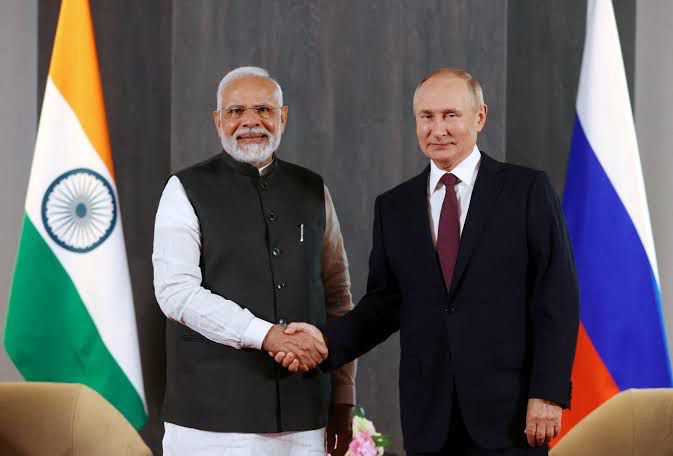
Prime Minister Modi’s personal rapport with President Putin has been viewed as one of India’s biggest diplomatic assets in the crisis. Modi and Putin share a long-standing strategic partnership built over decades of India-Russia cooperation in defense, energy, nuclear technology, and geopolitics. At the same time, Modi succeeded in establishing constructive engagement with President Zelenskyy, including direct conversations focused on humanitarian concerns, civilian safety, and the need for negotiations.
India has also consistently highlighted the broader economic consequences of the war on developing nations. Using platforms such as the G20 and Global South summits, New Delhi emphasized how the conflict disrupted food supplies, fertilizer exports, fuel markets, and global inflation, severely affecting poorer countries across Asia, Africa, and Latin America. This positioning helped India emerge not merely as a neutral observer, but as a voice representing nations suffering indirectly from the war.
Strategic experts believe India’s role could become even more important if formal negotiations eventually resume. Unlike NATO countries or close Russian allies, India maintains a rare level of strategic trust with both Moscow and Kyiv. This trust, combined with Modi’s personal diplomacy and India’s rising global influence, gives New Delhi leverage that few other capitals currently possess.
Although no immediate ceasefire or peace agreement appears imminent, the changing rhetoric from Moscow and increasing international focus on diplomacy suggest that a new phase of the conflict may be emerging. In that scenario, India is expected to remain a central player in efforts to bring both sides back to the negotiating table.
For New Delhi, the Russia-Ukraine conflict has become more than a geopolitical challenge — it has evolved into a defining test of India’s growing global role as an independent power capable of balancing strategic interests while advocating peace. As the war enters what could become its final diplomatic chapter, Prime Minister Narendra Modi’s engagement with both Putin and Zelenskyy may prove critical in shaping the contours of any eventual settlement.