VNA Lakshman | 12 Aug 2026
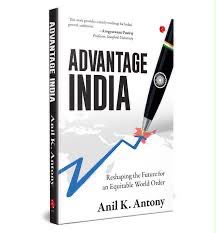
India’s growing economic and geopolitical weight has produced an expanding debate over what its rise could mean for the international order. In Advantage India, BJP national secretary and spokesperson Anil K. Antony enters that debate with an optimistic assessment of the country’s transformation and a roadmap for its emergence as a major global power by 2047.
Drawing on his experience in technology, public policy and politics, Antony examines how economic growth, technological capability, national security, democratic institutions and India’s civilisational traditions could collectively shape the country’s future.

The book is organised into two broad sections. The first, The India Story, focuses on the domestic foundations of India’s rise, covering economic development, semiconductors, artificial intelligence, digital public infrastructure, defence, space, the green transition, education, women and young people. The second, India and the World, examines the changing international system, India’s foreign policy choices and the country’s possible role in reshaping global governance.
A central argument running through the book is that India’s recent progress should be viewed as the result of accumulated national capability and institution-building rather than a collection of individual policy successes.
Education and skills occupy an important place in this framework. Antony sees the National Education Policy as an attempt to shift learning away from memorisation and towards creativity, flexibility and critical thinking. India’s large young population, he argues, will become a genuine economic advantage only when accompanied by better education, employable skills and increased participation of women in the workforce.
Technology emerges as perhaps the strongest thread in the book. Antony argues that India must move beyond its traditional role in global technology and manufacturing networks and develop the capacity to become a technological leader in its own right.
Semiconductors are presented as particularly important because domestic manufacturing could reduce strategic dependence on imports while attracting investment, research and highly skilled employment. India’s expanding digital public infrastructure is also portrayed as a potential model for developing countries seeking to deliver public services at scale.
The same emphasis on self-reliance and capability extends to national security. Antony argues that India needs a defence strategy capable not merely of responding to threats but anticipating emerging challenges. Greater domestic defence production, he says, should be combined with international partnerships and active participation in shaping rules for new strategic domains.
Space exploration and climate policy are similarly presented as areas in which India could expand its international influence while addressing domestic development requirements.
The book also attempts to place India’s democratic and pluralistic traditions within a longer historical framework. Antony connects contemporary democracy with older traditions of deliberation, referring to institutions such as the Vajji Confederacy and Buddhist assemblies.
Civilisational pluralism, in his account, provides another source of strategic strength. India’s ability to accommodate different traditions and identities, rather than pursue uniformity, is presented as relevant not only to domestic stability but also to the way the country engages with an increasingly diverse world.
The geopolitical argument becomes more prominent in the book’s second half. Antony sees the international system moving decisively towards multipolarity, with institutions created in the aftermath of the Second World War struggling to adequately represent present-day economic and political realities.
India, he argues, should therefore seek more than additional space within existing institutions. It should participate actively in redesigning global governance so that emerging economies and the Global South receive greater representation.
This approach also shapes Antony’s interpretation of Indian foreign policy. Rather than relying on permanent alliances, he favours strategic flexibility and partnerships built around particular interests. Such an approach would allow New Delhi to deepen relations with the United States, Europe and Japan while maintaining ties with Russia and strengthening its leadership role across the Global South.
The final chapter brings these themes together around India’s centenary of Independence in 2047. Antony acknowledges that significant challenges remain, particularly in raising per capita income and productivity and ensuring that the demographic dividend does not become a missed opportunity.
Yet the book remains firmly optimistic. It argues that India’s future global influence will depend not on economic expansion alone but on the combined strength of its institutions, technological capabilities, human capital, security preparedness and diplomatic credibility.
Advantage India is an accessible and wide-ranging contribution to the growing literature examining India’s emergence on the world stage. Its perspective is predominantly affirmative, concentrating more heavily on possibilities and policy opportunities than on the shortcomings and contradictions accompanying India’s development.
Its principal strength is the attempt to connect subjects often considered separately — technology, education, defence, demographics, democracy, diplomacy and civilisational identity — into a single account of national power.
Antony’s background in Silicon Valley and Indian politics gives the book a distinctive technology-and-policy perspective. The result is less a conventional account of India’s recent economic rise than a forward-looking argument about the capabilities the country will need if it is to translate its present momentum into lasting global influence.
For policymakers, students of geopolitics, public policy researchers and general readers interested in India’s changing place in the international system, Advantage India offers a readable blueprint of how one of the world’s fastest-changing major economies could approach the road to 2047.