By Arun Neyyan
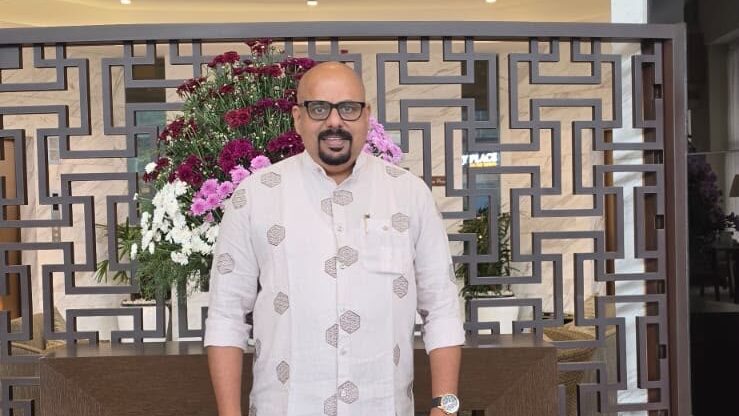
For more than two decades, Deepak Dharmadam has pursued stories from some of the most demanding reporting grounds in India—from the Kargil sector and the country’s border with China to Kerala’s political corridors, forests, police stations and sporting arenas. Now, the senior journalist and film artist hopes to strengthen another dimension of his public life by taking up substantial roles in cinema.
Currently serving as Associate Executive Editor at 24 News and Flowers TV, Deepak has established himself as a familiar presence in Kerala’s media landscape. Although journalism remains central to his career, acting represents an equally compelling form of storytelling for him. He is looking forward to suitable opportunities that will allow him to explore serious and memorable characters on screen.
Deepak’s interest in cinema is not a sudden departure from journalism. Both fields, in his view, depend on observation, emotional understanding and the ability to communicate convincingly. Years spent meeting people from different backgrounds have given him an intimate understanding of human behaviour—an experience that could prove valuable before the camera.
Rather than pursuing roles merely for visibility, Deepak is hoping for characters with depth and relevance. He believes his age, professional experience and exposure to real-life situations equip him to portray authoritative and mature roles. Characters such as journalists, investigators, police officers, military personnel, political figures or senior administrators could naturally draw upon his extensive experience in the field. At the same time, he is keen to move beyond familiar territory if offered challenging roles by filmmakers.
Born into the Kalathil family of Dharmadam in Kannur district, Deepak built his reputation through assignments across print and television journalism. His career has been marked by political reporting, investigative journalism and specialised coverage of defence, sports, health, energy, transport, business and development.
Defence reporting became one of his strongest professional areas. He reported from the Kargil region and covered military activity near the India-China border. His official profile states that he was the only journalist from South India selected to cover an Indo-US joint military exercise along the China border. He also participated in events including Kargil Vijay Diwas and the President’s Fleet Review in Visakhapatnam.
Such assignments required more than the ability to report quickly. They demanded preparation, physical endurance and a clear understanding of national security. Deepak’s work in this field earned him recognition as a defence commentator, and he has frequently appeared as a media expert on security-related developments.
His investigative reporting has also taken him into difficult and sometimes dangerous territory. Deepak’s 2005 book, Keralam Bheekararude Swantham Nadu, brought together reports dealing with militancy and extremist networks. According to his profile, his reporting on terrorism led to threats, while he was also physically attacked during field assignments. These experiences strengthened his conviction that journalism must remain grounded in public interest, even when reporting carries personal risks.
Deepak’s ability to establish trust with newsmakers has helped him secure interviews with prominent political and cultural personalities. His interviewees have included Kerala Chief Minister Pinarayi Vijayan, former Chief Minister Oommen Chandy and former Deputy Prime Minister L.K. Advani. He also conducted what was described as the final interview given by celebrated Malayalam writer M.T. Vasudevan Nair—an interaction that holds a special place in his journalistic career.
His reporting has not been confined to India. Assignments have taken him to the United Kingdom, Australia, Singapore, Malaysia, Bahrain and the United Arab Emirates. During his visits to Dubai, Sharjah, Abu Dhabi and other expatriate centres, he focused particularly on the problems faced by non-resident Indians. By bringing their concerns into mainstream discussion in Kerala, he helped connect stories of migration and hardship with families back home.
Sports journalism forms another major chapter in his career. His coverage of sporting events and personalities earned him the Kerala Government’s G.V. Raja Award for sports journalism. Over the years, he has received several other honours for investigative, political, developmental, business and television reporting.
Among the recognitions listed in his profile are the V.K. Madhavankutty Media Award, the Kesari Visual Media Award, State Energy Conservation Media Award recognition, Kerala State Television Awards and the P.V. Swami Memorial Award for developmental journalism. He has also received the AIMA Award for Best Interviewer, the Prem Nazir Award and honours from organisations associated with defence, business, cinema and social service.
Beyond the newsroom, Deepak has maintained a close association with journalism education. He conducts seminars, lectures and masterclasses for students, sharing practical lessons on sourcing, verification, field reporting and interviewing. He is also a member of the Kerala Media Academy and previously served on the State Press Accreditation Committee and the Union government’s Telecom Advisory Committee.
For Deepak, cinema offers an opportunity to carry the accumulated experiences of this eventful career into a different creative space. A reporter learns to observe people without immediately judging them; an actor must understand a character before portraying one. That common foundation makes his transition from reporting real lives to interpreting fictional ones appear natural.
Deepak is aware that a recognisable name in journalism does not automatically guarantee meaningful opportunities in cinema. He is prepared to wait for the right roles—characters that contribute to the narrative rather than merely provide a fleeting appearance.
Supported by his wife, Neetha Deepak, an HR professional from Kozhikode, he continues to balance newsroom responsibilities, teaching engagements and his interest in films. Even as he remains committed to journalism, he hopes directors and writers will recognise the acting potential shaped by decades of observing conflict, courage, ambition and vulnerability at close quarters.
After spending much of his professional life telling the stories of others, Deepak Dharmadam is now waiting for cinema to offer him a powerful character—and a story he can inhabit himself.