
Manacaud Suresh/Thiruvananthapuram
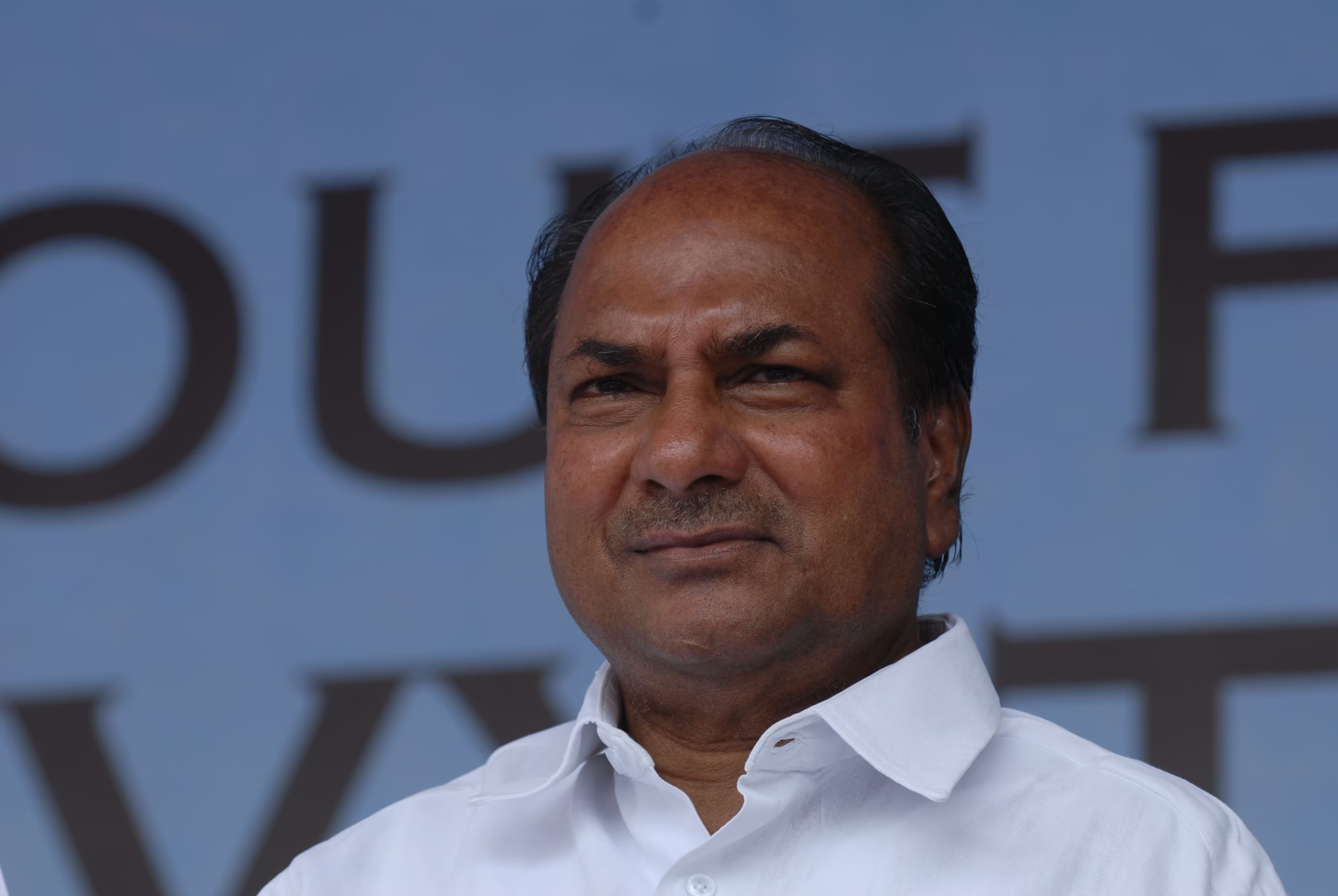
There is only one thing that shines brighter than truth itself — and that is the person who embodies truth. Former Kerala Chief Minister and India’s former Defence Minister A.K. Antony has once again shown the power of moral courage by speaking with unflinching honesty at his recent press conference.
In doing so, he reminded not just Kerala, but the entire country, of a rare moment in Indian history when even Mahatma Gandhi admitted he had no answer.
That moment is recorded in Mahatma Gandhi: The Last Phase by Gandhi’s secretary and biographer Pyarelal Nayar.
Not long after Independence, General K.M. Cariappa, the first Commander-in-Chief of the Indian Army, met Gandhi and asked him a difficult question: “As a military leader, how do I teach my soldiers the principle of non-violence?” Gandhi reflected for a long moment before replying, “I am groping in darkness for an answer.
One day, I will find it and tell you.” That answer never came. Within months, Gandhi was felled by an assassin’s bullet. Perhaps this was the only question in his long life that Gandhi could not resolve — the dilemma of reconciling the duties of a ruler with the purity of his ideals.
It was this unfinished answer that Antony, decades later, seemed to complete when he told the press, “Those in power have certain duties, and sometimes those duties weigh heavily.”
In those few words, Antony summed up the eternal conflict between moral conviction and the demands of governance.
What set Antony’s words apart was not merely the philosophical depth but his personal sincerity. Unlike leaders who glorify violence, justify repression, or remain silent about mistakes, Antony admitted openly that there had been failings during his tenure as Chief Minister and that he still carried sorrow for the bloodshed of those years.
He reminded the public that rulers must accept lapses when they occur, must grieve for all conflicts whether they happened during their tenure or not, and must never rejoice at the sight of blood.
This confession was not the language of politics but of conscience. It was a statement few rulers in India — whether Left, Right, or Centre — have ever dared to make.
Neither the Left nor the Hindutva camp, nor even many of his contemporaries in the Congress, have shown the moral courage to admit fault in such unambiguous terms.
Antony’s willingness to stand before the public and say “yes, there were lapses” is what made his words resonate deeply. It was a reminder that truth in politics is not about convenience but about accountability.
His stance reflected the very ideals of truth, non-violence, and moral clarity that Gandhi represented, and which the Congress tradition once carried with pride.
Antony’s sincerity was not limited to words. History bears witness to how he handled the sensitive Sivagiri issue with patience, restraint, and respect for judicial authority.
At that time, there was every possibility of communal and political confrontation. But Antony’s calm approach, rooted in the values of secularism and moderation, prevented dangerous escalation.
Even his political opponents in the Left, from E.K. Nayanar to Pinarayi Vijayan, were forced to acknowledge his measured handling of the situation.
Had Antony not acted with such composure, Kerala might have witnessed a rupture that would have scarred its social fabric. Those who today try to lecture Antony and the Congress on the legacy of Sree Narayana Guru’s secular vision would do well to remember that it was Antony’s stewardship that kept Sivagiri from being torn apart by discord.
Critics often cite the 2003 Muthanga tribal agitation as a failure of his government, but a serious look at history reveals otherwise.
The question of land distribution in Kerala was not created by Antony or the Congress. Its roots go much deeper, to the skewed land policies of earlier governments and the incomplete reforms of the EMS ministry
. It was Antony’s government, far from ignoring the problem, that first proposed a structured solution through the Tribal Resettlement and Development Mission.
Under this scheme, nearly 15,000 families received between one and five acres of land each.
Later, the UDF government expanded this into a full rehabilitation package and placed the community under the protective framework of the Fifth Schedule of the Constitution.
Antony, unlike most politicians, did not deny the pain of Muthanga. He did not attempt to whitewash the tragedy or shift blame. Instead, he stood before the people and admitted his anguish, acknowledging that as Chief Minister he carried the burden of responsibility.
That openness set him apart. No Left government in Kerala’s history has ever admitted mistakes in episodes where police opened fire or where lives were lost in political clashes. Antony did. And by doing so, he reminded Kerala that governance is not merely about the exercise of power but about the acceptance of responsibility.
This distinction between power and responsibility is what has defined Antony’s long public life. Thrones and palaces never tempted him; he has never been known to crave the glamour of office.
If anything, he has been accused of being too reluctant to hold power, too unwilling to play political games. But that very detachment from power gave him the moral strength to stand apart from the crowd. For Antony, politics was never a career of convenience but a vocation of duty.
By admitting regret for the pain caused under his watch, Antony demonstrated what true leadership means: understanding that governance is not about personal prestige but about upholding moral responsibility.
His message was clear — a ruler is not just an individual but the face of an entire system. And when that system causes harm, the duty of the ruler is not to hide behind excuses but to confess, to grieve, and to learn.
In the India of today, where political culture is often reduced to loud rhetoric, denials, and justifications, Antony’s quiet honesty comes as a refreshing contrast.
It is no wonder that his press conference evoked such strong responses. At a time when public life is dominated by leaders who seek to divide rather than unite, Antony’s voice reminded people of an older, nobler tradition in politics — a tradition rooted in truth.
Antony has always said that he is, above all, a servant of his conscience. He has lived by that statement.
By admitting lapses, by expressing sorrow for bloodshed, and by handling crises with restraint, Antony proved that truth and politics can coexist, even if uneasily.
His words carried weight because they came from a man who never sought personal glory, who never clung to power, and who never compromised on integrity.
And that is why A.K. Antony remains more than just another politician in Kerala’s history. He is a statesman, a man of truth — a satyavaan. In the end, it is this rare sincerity that ensures he will continue to shine brighter than the very truth he embodies.
The writer is a senior Congress leader from Kerala