Chennai,March 27,2025
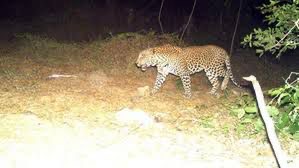
The Tamil Nadu forest department officials have installed surveillance cameras and set up cages in Mettur village of Salem district following villagers complaining of leopard presence in the area.
Villagers and farmers in the area have complained to the forest department that a leopard has recently been attacking local livestock, including dogs, goats, and chickens owned by farmers.
Farmers have urged the forest department to capture and relocate the leopard to a remote forest area.
Mettur forest department officials visited the location to assess the situation. After examining the footprints, they confirmed that a leopard was behind the attacks
Forest officials have warned villagers to stay indoors at night after the leopard was sighted in the locality on Wednesday.
A forest official added that in nearby areas such as Vanniyanur, Kaveripuram, and Kathiripatti, a leopard has recently been attacking local livestock, including dogs, goats, and chickens owned by farmers.
Meanwhile forest officials have advised the public, especially children and the elderly to stay indoors, avoid sleeping outside, and not take livestock into the forest for grazing.
It may be noted that Tamil Nadu has recorded a 23% increase in the leopard population to 1,070 in the 2022 census from 868 in 2018, while the population recorded an 8% increase in pan-India level to 13,874 from 12,852 during the period.
The census report was released in March 2024 ,by the National Tiger Conservation Authority (NTCA) in New Delhi.
Belonging to the cat family and considered vulnerable, leopards play a key role in the ecosystem.
The census, which was fifth of its kind, was carried out by the NTCA and the Wildlife Institute of India (WII) in association with the state forest departments, as part of the quadrennial monitoring of tigers, co-predators, prey and their habitat in the tiger range states.
The census focussed on the forested habitats in the tiger range states for carnivore sightings and prey base estimation.
While the leopard population in the western ghats is widely distributed, as per the report, they are facing repercussions of habitat loss and fragmentation, and the threat of poaching.
Also, the leopard-human conflict is prevalent in the entire landscape and has increased in recent times, as the leopards inhabit the human-dominated matrices.
In the western ghats, it said, more than 65% of the leopard population was present outside the protected areas.
At 13 leopards per 100km2, the report said, the Nilgiri forests accounted for high-density leopard population.
The Mudumalai Tiger Reserve (MTR) in the Nilgiris recorded the highest number of 135 leopards among the five tiger reserves in the state.
As per the report, another 220 leopards are also utilizing the tiger reserve.
With 131 leopards, the Sathyamangalam Tiger Reserve (STR) was placed second in the list.
The report said another 190 leopards were also utilizing the STR. The Anamalai Tiger Reserve (ATR), which is home to 121 leopards, is placed third in TN.
While the Kalakad Mundanthurai Tiger Reserve (KMTR) is home to 51 leopards, the Srivilliputhur-Megamalai Tiger Reserve (SMTR) houses 97 leopards.
The KMTR and SMTR are also utilized by another 87 and 147 leopards, respectively.
According to Tamil Nadu forest department officials ,the leopard census was part of the 2022 tiger census.
A senior official of Tamil Nadu forest department said that the leopard census was separately held using the methodology adopted for tiger estimation.
Not only in the five tiger reserves, but the exercise was also carried out across the reserve forests in the state.
The official also said that good protection and care for the forest are the main reasons for it and poaching is being properly monitored and stringent action being taken.
The home range for a leopard would vary depending on the prey base and the type of the forest and officials said that in many locations, tigers and leopards are comfortably co-existing.