By Lindsay Rose Jordy | 22 September 2023
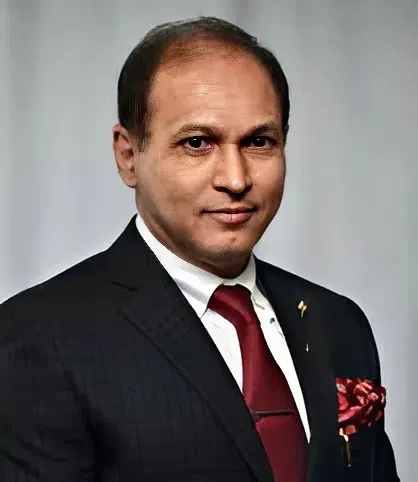
H.E. Dr Nawab Mir Nasir Ali Khan was appointed as the Honorary Consul of the Republic of Kazakhstan in Hyderabad for the states of Telangana and Andhra Pradesh by the External Ministry of the Republic of Kazakhstan on 15 January 2021 and approved by the President of India on 20 January 2021. In the interview conducted on 17 September 2023, he talked about his life as a diplomat and a businessman.
Being the Honorary Consul, what are your jobs and responsibilities?
I work on the bilateral relationship between India and Kazakhstan, including export and import and government-to-government relationship. The relationship between India and Kazakhstan is extremely good. Imports from Kazakhstan to India are about 2.3 billion dollars, which is mostly oil and uranium. Being the largest producer of uranium in the world, 80% of the uranium supplied to India is supplied by Kazakhstan. Exports are basically pharmaceuticals and some engineering goods. Imports from India are about 300 million dollars. The import is very high while the export is low; there is a difference of almost 2 billion dollars. So, we are trying to increase the export from India to Kazakhstan to bridge the difference. That is the reason we were trying to get Indian companies to do projects there and work in Kazakhstan. We’ve been successful so far. There are companies promoted by India, including ArcelorMittal and Vedanta Limited. Last month, an agreement was signed with OneWeb, part of Bharti Airtel, to do remote connectivity in Kazakhstan. Kazakhstan is a hydrocarbon economy mostly of oil, gas and minerals. It is located next to China and Russia, which is a very important and strategic location for the United States, India and other countries to maintain commercial connections. My interest is to promote India in Kazakhstan. We are trying to take some Indian companies into Kazakhstan. We are currently talking and working with the Adani Group to initiate a power project in Kazakhstan. Efforts are being made to take some Pharma companies to Kazakhstan to manufacture locally, and also to export.
What are the hardships you face in maintaining and bettering the bilateral connection?
Basically, I’m lucky because India- Kazakhstan relationship is very good. The people-to-people and government-to-government relationship is good. So, it’s really very helpful. India and Kazakhstan have a very old relationship culturally. But the challenge for Indians, what I see, is language; it is a barrier, as Kazakhstan is basically a Russian-speaking country. The other challenge is connectivity to Kazakhstan, which is very limited. The challenge for me is that there are only two flights to Kazakhstan every day from Delhi; however, we are introducing one more flight. But we don’t have flights to Kazakhstan from any other city. And the third challenge is that we need to educate people in India about Kazakhstan, as the awareness about the country in India is very low. Unfortunately, the number of Indians in Kazakhstan is very low. The only high numbers are students. It is very inexpensive to study in Kazakhstan; the degree is valid in a lot of countries, and they can come back, write a medical council exam and then practice in India.
The other challenge for me was there was a visa for Indians to go to Kazakhstan. So, we spoke to both the governments; thanks to our Prime Minister and the President of Kazakhstan, they worked on that, and they have removed the visa for Indians. Now, if you want to travel to Kazakhstan, you don’t need a visa. It’s a visa-free country, and it’s just three and a half hours from Delhi. It’s not too far; it’s very close, and it’s a big country with a lot of opportunities. So, I think in the long term my interest would be to promote Indian companies and also work on other areas like taking Indian doctors and Indian IT professionals to Kazakhstan to improve their medical infrastructure and education system. Hyderabad has a very good medical hospital. Since there is not good connectivity between Kazakhstan and Hyderabad, people don’t come to Hyderabad; they go to Delhi. So, my interest is to start a direct flight from Hyderabad to Kazakhstan. I have had a couple of rounds of meetings with GMR Airport, which is an airport operator in Hyderabad. We will talk to Air India Express to see if we can have direct connectivity between Hyderabad and Kazakhstan. If we have that, we can bring a lot of medical tourism to Hyderabad from Kazakhstan.
Can you explain the workings of MAK Projects Pvt. Ltd and how you incorporate sustainability into your works?
Apart from my diplomatic assignment, I am also in the business of luxury housing. We do clean, green, healthy living. With low-rise independent houses and integrate the housing with sports and entertainment. According to me, health is a new luxury. So, we provide all these sports facilities, a lot of parks, so people can walk around, cycle and jog in the tracks. Then we also do a little bit of entertainment, like a theatre, recreation like a set, salon, a spa and all that.
People who live with us, if they want to go for theatre or the spa or play cricket, they have it within our campus. We want to decongest the city and save time for people. That is our concept.
Recently, we have been working with Canadian Wood and making carbon-negative homes from wood. So, the advantage is that wood is biodegradable, recyclable, reusable and eco-friendly and carbon negative. It is quick to make, and it is dry construction; we don’t use any steel, cement or sand, and we don’t use water. And we buy from Canada because it is legal, reliable and sustainable, and when they cut one tree, they plant three trees in Canada. Making sure that the forest cover will not go down. In the last ten years, with this reforestation, they have increased the forest cover by 10%. Also, wood is the only natural material that is renewable, as you can replant them. The reason is we want to give a better world to the next generation. Now, because of this climate change, global warming, there are floods in some countries and droughts in some others. We are very conscious about that. The countries under the Paris Accord have a commitment that they have to be carbon neutral by a certain period of time. India has time till 2070, and Kazakhstan has time till 2060. But for a country the size of India and Kazakhstan to become carbon neutral by that time, it’s a challenge. So, now we are trying to bring down the pollution in manufacturing. Another reason is that wood is very good during earthquakes because wood is a very light material. It is good for health as well, and the biophilic properties of wood are very good. We have solar power and our own water recycling. We recycle 100% of water. And our projects are all zero discharge and sustainable.
What is your advice to the future entrepreneurs?
I advise everybody to dream big, aim for the sky and work towards it.
Just dreaming is not enough. There’s no alternative to hard work. But along with hard work, when you want to be successful in life, you have to have commitment and consistency. Commitment can take you to the starting line. Consistency can take you to a finish. I tell the young generation, please do not give up and balance everything in your life. Take care of your health and family; they are very important. If you are serious and committed about what you’re doing, I’m sure you’ll be able to achieve it. The advantage in the young generation is that they have a lot of knowledge; they have a lot of information. Processed information is knowledge. See, whatever information you get, you have to process and make it your knowledge. And since you have access to information, you know what is happening globally; you have a lot of opportunity. I think earlier it was people who had money who could do business, set up factories and all that. Then people who had knowledge could do a knowledge-based economy.
Now it is the time of ideas. An innovative idea. Like most of the successful new enterprises and information technologies are ideas like Google, Uber and so on. In conventional business, what happens is that your turnover and profits are important. But in the business of technology, information technology or software, it is not just your turnover and profit. Sometimes it is your potential in what you have. So, technology is important; you have to accept technology in life. It makes life easy and also cheap. But use it for the right purpose. Please do not misuse or abuse anything; then it is dangerous and can hurt you or others.
According to you, what are the duties of a citizen?
I will tell you, there is a lot of lack of awareness on this. See, the Constitution has roles and responsibilities for the government and also for the citizens. It’s not that citizens don’t have any responsibility. But the problem is generally people tend to blame the government for everything. Traffic control, cleanliness and all that are the responsibilities of individuals too. One of the ministers, when I was talking to him, was telling me, ‘If you don’t throw garbage on the road, the cleaning will be easier.’ So, if you ask me, I think citizens are equally responsible for their actions. There are unwritten rules too, as everything cannot be written down. So, once you follow the rules, it is easy for the government to implement their policies. Like plastic water bottles or plastic bags and all that. Even if there’s a ban, people are producing, and people are buying.
If nobody wants to use them, there won’t be any production. So, people have to take responsibility: “No, I will not buy single-use plastic. Then nobody will produce. Same thing with other products. This helps in sustainability.
Like you insist that you will buy only sustainable products, then that will help. And sustainability is not just in manufacturing or automobiles. Even agriculture too, sustainable agriculture is very important now. Grow what is local and grow what is suitable to the local weather. In fact, doctors are advising eating local vegetables and local fruits. You have to learn from the West the good things, not everything. You have to learn punctuality and professionalism. I’m not against it. You can learn from so many countries.
We have to go back to nature. I’m telling you one thing. Nature is all beautiful, all powerful. If you destroy nature, nature will destroy you. If you protect nature, it will protect you. Do not destroy nature, and try to have local fruits and vegetables; and everybody has to stay healthy and happy. Because healthy people are productive. When somebody is healthy, he goes to work and produces. When somebody is sick, he’s a drain on the economy.
How do you manage the two worlds of diplomacy and business together?
It is a big challenge for me. One is I have to do justice to my company because I employ people, I have customers, they have some expectations from me. I have employees; I have to pay salaries, I have to pay taxes. So that is my responsibility when it comes to my company; I’m very serious about that. And when it comes to diplomacy, it’s my passion. I like to do it. When I took up this assignment, I knew it was a big challenge for me, but the idea was to bring investment between the two countries, improve diplomatic relations between India and Kazakhstan and also get investment in India from Kazakhstan; plus, I help Indian companies to invest there or do business. That is the passion that is driving me. But it is a tough job handling two assignments because one of my assignments needs a lot of travelling. It takes time, but I love to travel. That is one good thing for me. Even though it is a challenge, I do a balancing act.
I try to do the best in my business to protect the interests of my employees, my customers, government taxes and all. In fact, we have received the award for punctual payment of GST on time for the last two years from the Ministry of Finance; an appreciation letter that we have been very punctual and have been contributing to GST for the development of the nation. And on the diplomatic side, I was given the award recommended by the Parliament of Kazakhstan, and the President of Kazakhstan has given me the Jubilee Award for improving the relationship between India and helping Kazakhstan. I have been trying my best to balance, and I think so far so good. I’ve been successful in both. I have got recognition, and I have got awards from both governments.
So, I’m very happy, and I’m really grateful to everybody. Actually, I believe that my success, what I am today in my business it’s because of my employees, my customers, my suppliers and my contractors. They have all been great support to me. In my diplomatic assignment, I’ve been successful because of support from the Government of India, support from the Government of Kazakhstan, support from the Indian Embassy in Kazakhstan, support from the Kazakhstan Embassy in India, in Delhi and also, more importantly, my family. You have to have good support from your family, your wife, your children, and I believe my success is God’s will.