By Lindsay Rose Jordy | 8 October 2023
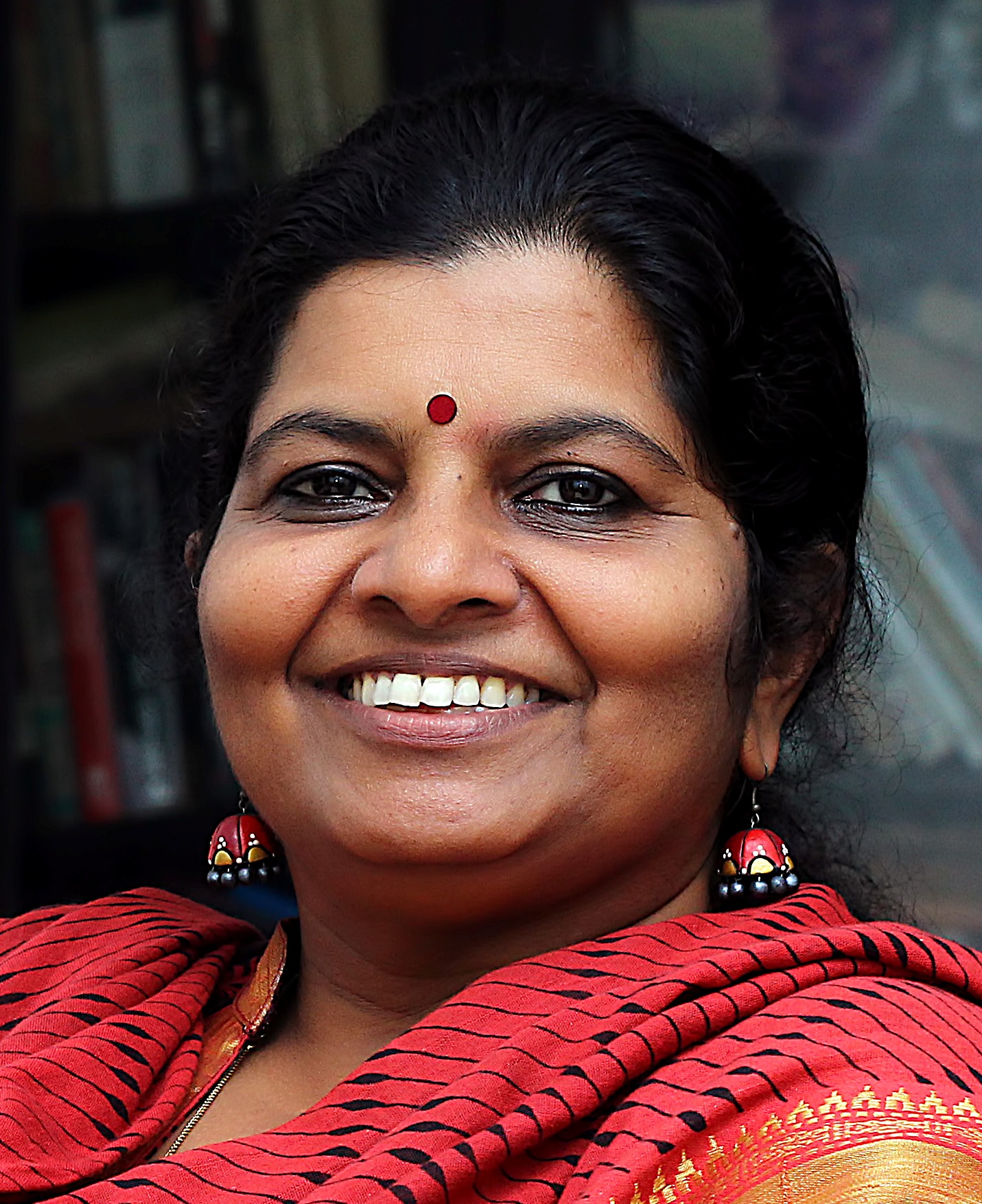
Born in Vazhayila, Thiruvananthapuram, Kerala, K. A. Beena is an acclaimed Malayalam author, journalist and columnist. Her literary journey began at the age of thirteen when she wrote her first work, a travelogue, later published as Beena Kanda Russia, marking the beginning of a writing career that has spanned more than four decades. Since then, she has worked across print, radio, television and digital media while producing an extensive body of writing ranging from children’s literature and travel writing to journalism and memoir.
What persuaded you to write Beena Kanda Russia?
My mother was an avid reader, and I developed a love for books at a very young age. During my childhood, a children’s organisation called Balavedi was started in our locality, and my uncle enrolled me in it when I was ten years old. I later became the district president of the organisation. We travelled to schools and various other places to conduct programmes and activities. In 1977, I went to Russia as part of a group of children who were selected to represent India at the Artek camp in the Soviet Union. There, I performed Bharatanatyam and participated in painting competitions. When I returned home, everyone around me was so curious to hear about my experiences in the Soviet Union. After narrating the same stories repeatedly, I grew tired of telling them. It was my mother who suggested that I write about my time in Russia so that people could read them instead.
I had kept a diary during my stay at the camp, and I referred to it while writing. I also visited several libraries to learn more about the Soviet Union and enrich the travelogue. Once I completed the manuscript, we sent it to Mathrubhumi Weekly. M. T. Vasudevan Nair, who was the editor at the time, wrote back saying that they were willing to publish it. That is how Beena Kanda Russia first appeared in print. It was very well received by readers as at the time, a travelogue written by a child and published in a weekly magazine was something quite new and people of the time were used to reading stories set in the back drop of the Soviet Union as well. DC books later published it as a book. After its publication, M. T. Vasudevan Nair wrote to me encouraging me to continue writing for Mathrubhumi. He also told me about Grihalakshmi, a new magazine they were planning to launch. I began writing for Grihalakshmi while I was still in the tenth standard. 2023 marks my 46th year of writing.
How would you describe your journey towards becoming a journalist?
I completed my bachelor’s degree in English before pursuing a master’s degree in Journalism. My father was a journalist; he would travel extensively, write letters to me and tell me about the opportunities that journalism offered. Even after the publication of Beena Kanda Russia, I continued writing for several magazines, which helped me stay connected with journalism. I was determined to study journalism because I believed it would enable me to contribute to social movements and bring about meaningful change through my work. After completing my studies, I received an offer from Kerala Kaumudi, where I began my career as a journalist. During my time there, I conducted interviews and wrote several articles and feature stories. I was fortunate to work under editors such as S. Jayachandran Nair, N. R. S. Babu, A. P. Vishwananthan and N. P. Narayana Pillai, whose guidance motivated me and strengthened my belief that journalism could be a powerful instrument for social change. I resigned from Kerala Kaumudi after two years to take care of my baby. Around that time, M. T. Vasudevan Nair invited me to work for Grihalakshmi from home, allowing me to continue writing while balancing my family responsibilities. In 1991, I joined the Indian Information Service under the Government of India. Over the years, I served as News Editor at Akashvani (All India Radio) and Doordarshan. I was posted in Guwahati for two years and also worked with the Press Information Bureau and the Directorate of Advertising and Visual Publicity. I eventually took voluntary retirement as Deputy Director of the Bureau of Outreach and Communication under the Ministry of Information and Broadcasting.
What has your experience been like working across different forms of media?
When I entered the profession in 1991, it was uncommon for women in Kerala to travel extensively for work. Women’s mobility outside the home was limited, and people often questioned whether it was even necessary for women to work, asking, “Isn’t marriage enough?” My work required constant travel. I would spend days away from home organising photo exhibitions, film screenings and public awareness programmes in different parts of Kerala and across India. At that time, even something as simple as a woman dining alone in a restaurant or checking into a hotel by herself was looked down upon. I often stayed in working women’s hostels or with relatives while travelling. Those experiences made me realise the many challenges women faced in pursuing professional careers.
When I became the News Editor at Akashvani, I was the first woman to hold the position there. Initially, one of the officers opposed my appointment, arguing that the role involved extensive travel and that it would be inappropriate for a woman to travel with male colleagues. There was considerable resistance to my joining the post because of these assumptions. Despite those challenges, radio eventually became one of my favourite media, and I was able to accomplish a great deal through it. I later wrote Radio Kathayum Kalayum, a book on the history and techniques of radio broadcasting in Malayalam. During the fiftieth anniversary of regional news in 2007, while serving as News Head in Thiruvananthapuram, I coordinated month-long celebrations and introduced several innovative programmes. . During my tenure at Akashvani, I received both national and honorary awards, including the Akashvani Annual Award for Best Script. Being recognised at a place where I had initially been told I could not succeed was deeply satisfying. Later, I was posted to Assam, where I was in charge of seven states. The position gave me the opportunity to travel extensively across the Northeast. I wrote about those experiences in Kalakaumudi, and the series was later published as the book Brahmaputhayile Veedu (2007). Working as a news editor at Doordarshan was equally demanding. During my tenure, we successfully transitioned from the earlier system to the Electronic News Processing System (ENPS). That same year, Doordarshan was recognised as the country’s best news unit. I also had the opportunity to interview personalities such as Resul Pookutty and K. Satchidanandan.
While at Central Bureau of Communication I had the charge of Ernakulam, Alappuzha and Idukki districts. It remains one of the happiest phases of my career as I was able to travel extensively, engage directly with people in the field and participate in programmes across different districts. I served there for nearly ten years before taking voluntary retirement. More importantly, the experience helped me understand the realities of life among marginalised communities. On one occasion, I visited a village where I witnessed a panchayat president addressing the woman vice-president in a dismissive and disrespectful manner. That incident made me realise that political reservation alone had not brought about meaningful social change. I travelled across villages in different states, interviewing Dalit women and women panchayat vice-presidents about their lives and experiences. The resulting six-part series, published in Kerala Kaumudi, received the Madhavankutty Award for Print Media in 2016. I also received the Laadli Media Award for Print and Digital Media in 2014 and 2016, presented by Population First in collaboration with the United Nations Population Fund (UNFPA). I am currently revisiting many of those villages to document what happened to those women after our first meetings. Their stories will form the basis of my forthcoming book, Nooru Nooru Kaserakal. I have also written the travelogues Chuvadukal and Nadhi Thinnunna Deep, as well as Dateline – Charithathe Chirakilettiyavar, which documents the lives of legendary journalists through conversations conducted in their homes when my friend and I visited their houses. Over the years, I have written columns for Manorama Online, Mathrubhumi Online, Kerala Kaumudi, Deshabhimani, Janayugom and magazines such as Yathra, Vanitha and Kanyaka. Many of these columns were later compiled into essay collections, including Bhootha Kannadi, Ammamar Ariyathathu, Enthanu Sanitary Padinte Anthima Rahasyam and Athirthiyude Athiru. Friendship has always been one of the most important aspects of my life. I make friends wherever I go, and that inspired my memoir Perumazhayath, a book centred on friendship. When Beena Kanda Russia completed forty years, a commemorative volume titled Beena Kanda Russia @ 40 was published, featuring essays by sixty writers on how the book had influenced their lives, reading and writing. One of the most memorable responses I received was a reader telling me, “You made me a traveller.”
Although I began my career several decades ago, I continue to stay connected with younger generations and adapt to changing times. That gives me immense satisfaction, and I consciously write my columns in a way that remains accessible to contemporary readers.
Can you talk about your work in children’s literature?
Children’s literature is one of my favourite areas of writing. Today’s children may find it difficult to understand or relate to the portrayal of gender roles found in many older literary works. In my own writing, I consciously avoid stereotypes based on gender, caste and colour. The younger generation has grown up with a greater awareness of equality and is more conscious of discrimination based on gender, caste and race. One of the main reasons I write for children is to nurture values of equality, empathy and unity and through my stories, I try to encourage children to question and challenge the prejudices that continue to exist in society. Over the years, I have worked across various media platforms, including print, radio, television and digital media. The Reporter is a children’s book that introduces young readers to the fundamentals of news reporting, while Madhyamangalk Parayan Ullath explores how different forms of media should be understood and used responsibly.I am currently working on a book about the history of women in Malayalam media. I have also written short stories such as Kaumaram Kadannuvarunnathu and Sheethanidra. My contributions to children’s literature include Ammakkuttiyude Lokam, Ammakkuttiyude School, Ammakkuttiyude Albhuthangal, Miliyude Aakasham and Rosum Koottukarum.
Who are your favourite writers?
Among international writers, I particularly enjoy reading Orhan Pamuk and Milan Kundera. One of my favourite books is The Story of San Michele. However, the writer who transformed my life and influenced me most profoundly is Vaikom Muhammad Basheer. My postgraduate dissertation was titled Contribution of K. Balakrishnan and Kaumudi in the Growth of Malayalam Journalism. As part of my research, I wrote to several prominent writers who had contributed to Kaumudi, requesting their responses to a questionnaire. Most replied with brief letters. Basheer, however, sent me an eighteen-page letter. Although he wrote about K. Balakrishnan and Kaumudi, the letter reflected a deep warmth and affection. He addressed me as “Ponnambili” and continued writing to me until the end of his life. Whenever I visited Kozhikode, I never missed the opportunity to meet him. We shared a close relationship over the years. Basheerinte Kathukal, published by DC Books, is a collection of the letters he wrote to me. I later wrote Basheer Enna Anugraham, a book that reflects on his letters, our friendship, his unique way of speaking and the profound influence he had on my life. M. T. Vasudevan Nair also played an important role in my literary journey from a very young age. During the pandemic, he unveiled both the commemorative edition Beena Kanda Russia @ 40 and the fortieth anniversary edition of Beena Kanda Russia at his residence. I also had the privilege of working under him, as well as M. P. Narayana Pillai. I consider myself fortunate to have worked alongside such remarkable literary figures.
Which has been your most treasured travel experience?
The journeys I am currently undertaking for my forthcoming book Nooru Nooru Kaserakal are among my most treasured experiences. I have travelled to famous cities and monuments such as the Charminar and the Taj Mahal as a tourist, but the journeys that have stayed with me are those where I met ordinary people. We truly come to understand India when we travel through its remote villages. There, we encounter an India that continues to struggle with discrimination, and it makes us wonder how much longer it will take for that to change. I have always been comfortable travelling by public transport and interacting with ordinary people. I continue to believe in the principles of development journalism that I studied in college. Apart from these journeys, my visit to Russia remains one of the most cherished experiences of my life.
What do you think of the present situation of women in India?
I never grew up feeling that I belonged to the “weaker sex.” We were three daughters, and my father never raised us to believe that we were inferior. My mother was an avid reader and a woman who valued freedom. As a result, I never experienced gender discrimination within my own home. It was only later, while working with the Network of Women in Media, an all-India collective, that I fully recognised the extent of the discrimination women faced. In 2010, we established groups for women in media in Kozhikode, Thiruvananthapuram and Ernakulam. For nearly ten years, we organised programmes, held discussions and addressed issues affecting women journalists. As the coordinator, I realised that even within journalism, women face subtle forms of discrimination and gaslighting. They are often denied the same assignments and professional recognition as their male colleagues, while also having to navigate difficult working hours and the pressures of marriage and family life.
Women in Kerala are highly educated, yet we continue to live in a society that is deeply rooted in patriarchal values. Many people speak passionately about progress and social development, but fail to practise those values within their own homes. It is as though they leave their progressive ideals at the doorstep before entering the house. Men may watch films, read books and participate in public discussions while women continue to shoulder the burden of household responsibilities. Unless we transform the structure of the family itself, meaningful social change will remain difficult.My work at the grassroots level exposed me to many of these realities. I met women panchayat presidents and vice-presidents who told me they woke up as early as three in the morning to complete household chores before leaving for work. Although there are exceptions, I continue to hear similar stories from women across India. The guilt associated with not fulfilling domestic responsibilities remains deeply ingrained, and even I have experienced that feeling. Although younger generations are beginning to challenge these expectations, many people also choose to leave India because they find these social pressures difficult to escape.
Society continues to treat women as possessions. With the widespread use of mobile phones, people are under constant scrutiny, and in many ways the sense of personal freedom people once enjoyed has diminished. Patriarchy is not sustained by men alone; it is deeply embedded in the minds of both men and women. Unless those attitudes change, true liberation will remain elusive.In many families, conflicts between daughters-in-law and mothers-in-law reveal how deeply patriarchal values have been internalised. Instead of unquestioningly defending their sons, mothers should be willing to stand by what is right. Change begins within the family.A talented woman is often seen as a threat. Society imposes rigid expectations of what it means to be a “good” wife, daughter or mother, and many women lose their own identities trying to meet those standards. Even something as simple as travelling alone or taking time for oneself is still viewed negatively in many places.When it comes to women’s political representation, I believe genuine commitment matters more than reservation alone. If political parties truly believe in equality, they can nominate more women without waiting for legislation to compel them.
Despite working across print, radio, television and digital media throughout my career, I have often felt that women’s contributions to journalism receive far less recognition than those of men. Women are frequently invited only to discuss “women’s issues,” as though our expertise begins and ends there. We study the same subjects, report on the same issues and work with the same commitment, yet our voices are still treated differently. I have experienced this personally.At the same time, I believe significant progress has been made because generations of women fought for these changes. However, women continue to be conditioned to believe that pursuing their own ambitions somehow makes them “bad.” Unless gender is addressed more thoughtfully in education and the media, it will remain difficult to break free from these deeply rooted attitudes.
Did your personal life affect your writing?
I have experienced many personal tragedies in my life. My sister, who was one and a quarter years younger than me, suffered from Systemic Lupus Erythematosus and passed away. We grew up almost like twins, and her death deeply affected our entire family. I am someone who is deeply affected by the people and experiences around me. My father was diagnosed with cancer, and I spent four years taking care of him. Soon after his passing, my uncle, to whom I was very close, also died. These losses took a heavy toll on my mother, who later developed Alzheimer’s disease in her seventies; she lived with the illness for eight years and constantly needed someone by her side. Throughout all these difficult years, I continued to write. There were periods filled with travel, hospital visits and personal responsibilities, but writing remained my source of strength. It sustained me through every tragedy I experienced. Along with writing, travel, love and friendship became the pillars that helped me move forward, and whatever I have been able to accomplish in my life has been possible because of my love for these things.
Alongside my writing, I have always been on a journey of self-discovery. After my sister’s death, I went through a period of depression. However, meditation and other positive practices helped me avoid becoming consumed by grief and enabled me to move forward with hope. I believe this strength comes from my search for my inner self. It is not a religious journey but a spiritual one. Even today, I feel that I carry the same enthusiasm and energy as the young girl who wrote Beena Kanda Russia. That spirit continues to inspire me and keeps me writing.
Note: This interview was originally conducted in Malayalam and translated into English by the author. The text has been lightly edited for clarity and readability while preserving the interviewee’s original responses.