Thiruvananthapuram, Nov 28:
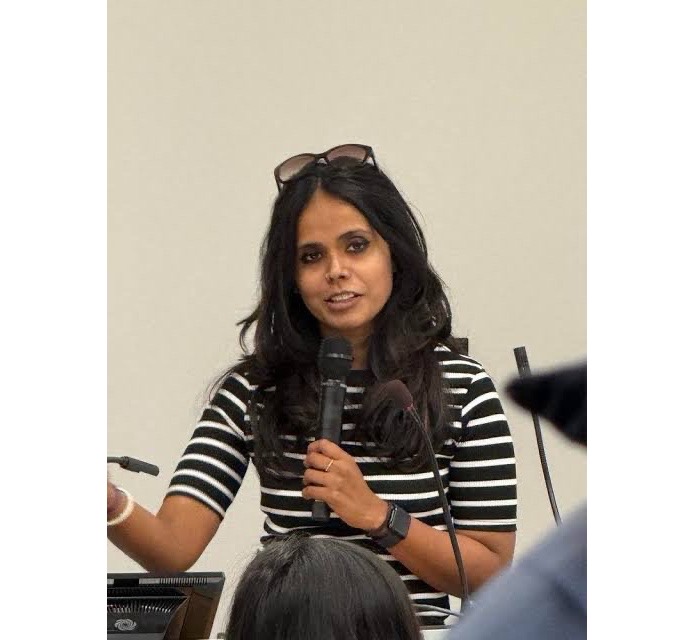
The inclusion of Tamil writer and activist Meena Kandasamy, an outspoken critic of Sanatana Dharma and Hindutva, in the Asianet News Agora 2026 has brought into focus the relationship between media ownership, editorial independence, religious sentiments and political accountability.
Asianet News, the prominent Malayalam television channel in which Kerala BJP president and former Union minister Rajeev Chandrasekhar has historically held substantial business interests, listed Kandasamy as a prominent speaker at its three-day intellectual and cultural festival at Kanakakunnu in Thiruvananthapuram.
The channel, in a promotional article published on November 22, celebrated Kandasamy’s uncompromising ideological positions and literary contributions. She was scheduled to participate in three sessions covering literature, history and contemporary youth movements.
Kandasamy’s public opposition to Sanatana Dharma is well documented. On September 10, 2021, she addressed the international Dismantling Global Hindutva conference, delivering a speech titled From Sanatana Dharma to the Sangh Parivar: The Evolution of Political Hindutva.
In her address, she characterised Sanatana Dharma as an ideological framework founded on inequality by birth, caste hierarchy and patriarchy. She also explicitly declared her commitment to challenging and dismantling Hindutva.
Her arguments, rooted in Ambedkarite, Periyarist and feminist thought, extend beyond criticism of the BJP’s political positions to a fundamental critique of traditional Hindu social and religious structures.
Her interpretation of Sanatana Dharma stands in sharp contrast to that of Hindu spiritual scholars and practitioners who regard it as a philosophical tradition encompassing universal consciousness, spiritual liberation, compassion and righteous living.
What makes the development particularly significant is Asianet News’ historical ownership connection with Rajeev Chandrasekhar, who heads the Kerala unit of the BJP.
Media Ownership Monitor has documented Chandrasekhar’s substantial indirect shareholding in Asianet News Network through Jupiter Capital and associated companies.
The relationship between Chandrasekhar and the channel’s editorial establishment has previously attracted attention.
In March 2025, Chandrasekhar publicly criticised an Asianet News programme dealing with the Maha Kumbh Mela after receiving complaints that its presentation had hurt Hindu religious sentiments.
He reminded the channel’s management that religious faith was important to millions of Hindus and deserved respect.
Against this background, Kandasamy’s invitation presents another occasion to examine the distinction between Chandrasekhar’s political commitments and the editorial decisions of a media organisation associated with his business interests.
There is nothing inherently objectionable about inviting a writer who challenges religious orthodoxy. Freedom of expression necessarily includes the freedom to question established beliefs, just as believers have the right to challenge interpretations that they consider inaccurate or offensive.
However, an intellectual festival organised by a major media institution must also withstand scrutiny regarding its selection of speakers, framing of discussions and accommodation of competing intellectual traditions.
Were scholars capable of presenting alternative interpretations of Sanatana Dharma given comparable opportunities? Were Kandasamy’s longstanding ideological assertions subjected to critical examination? What criteria governed the selection of speakers?
These are legitimate questions for the organisers of Agora, particularly when the festival describes itself as a meeting ground for diverse ideas.
Chandrasekhar’s political responsibilities and historical commercial interests in Asianet News make transparency regarding the relationship between ownership and editorial decision-making especially relevant.
At the same time, there is no verified evidence that Chandrasekhar personally approved Kandasamy’s invitation. Nor does inviting her to a literary festival necessarily constitute an endorsement of her ideological positions.
The larger issue, therefore, is whether Asianet News can demonstrate that its intellectual platform provides meaningful space for competing perspectives, including those of scholars who defend Sanatana Dharma while acknowledging the need to confront caste discrimination.
An ideas festival is ultimately tested not by the prominence of its speakers but by the intellectual diversity it accommodates and the seriousness with which competing viewpoints are examined.