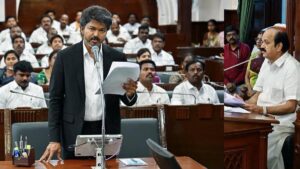
Thiruvananthapuram, June 19: Chief Minister and Finance Minister V.D. Satheesan on Friday unveiled the first Budget of the newly elected United Democratic Front (UDF) government, presenting an ambitious roadmap aimed at steering Kerala out of its financial difficulties while laying the foundation for long-term economic growth. The Budget marks a decisive departure from conventional fiscal approaches, placing strong emphasis on private investment, maritime development, healthcare, infrastructure and employment generation.
Presented against the backdrop of a severe fiscal crisis highlighted in the government’s recent white paper, the Budget seeks to balance welfare commitments with economic expansion. Satheesan used his maiden Budget speech to argue that Kerala can no longer depend solely on traditional revenue streams and must create new engines of growth to generate wealth, attract investment and create jobs.
One of the most significant announcements was the launch of Mission Samudra, a comprehensive maritime development initiative for which ₹400 crore has been earmarked. The project envisions transforming Kerala into a major maritime economic hub by integrating ports, railways, roads, inland waterways, industrial zones and emerging urban centres into a single logistics and trade ecosystem. The government believes Kerala’s 600-kilometre coastline and strategic location provide immense untapped economic potential.
In another major infrastructure initiative, the Budget announced the creation of the Southern Kerala Economic Corridor, integrating Thiruvananthapuram, Kollam and Alappuzha into a unified economic region. The government also proposed a Rare Earth and Critical Minerals Corridor to capitalize on Kerala’s mineral resources and attract high-value industries. Additionally, ₹200 crore has been allocated for preliminary work to develop Kerala into a major aviation and logistics hub.
Healthcare emerged as one of the biggest beneficiaries of the Budget. Delivering on a key UDF election promise, Satheesan announced the Oommen Chandy Health Insurance Scheme, which will provide annual health insurance coverage of up to ₹25 lakh for every family in the state. The scheme is intended to offer comprehensive protection against catastrophic medical expenses and strengthen Kerala’s public healthcare safety net. The government has made an initial allocation for the rollout of the programme and also indicated reforms to the existing Medisep health insurance system.
The Budget also places considerable emphasis on attracting investment and creating employment opportunities for the state’s youth. A new Global Job Watch Tower will be established to align educational and skill development systems with emerging employment trends across the world. The government hopes this initiative will help bridge the gap between academic qualifications and labour market requirements.
Reflecting the administration’s pro-investment stance, Satheesan announced plans for a “second phase” of land reforms aimed at improving land availability for industrial and commercial ventures. The government argued that outdated land regulations have become a barrier to investment and economic expansion. The Budget also promised support for private satellite manufacturing and launch enterprises, with land being made available for such ventures. A provision has been made to strengthen activities at the state’s Space Park.
The transport sector received several tax-related incentives, particularly for environmentally friendly vehicles. Road tax on electric vehicles priced up to ₹10 lakh has been reduced from five per cent to three per cent. For electric vehicles costing between ₹15 lakh and ₹20 lakh, road tax has been cut from eight per cent to five per cent. However, luxury electric vehicles priced above ₹40 lakh will attract a higher road tax of 15 per cent, up from the existing 10 per cent. The government said the changes are intended to encourage wider adoption of electric mobility while ensuring that premium vehicle owners contribute more.
The tourism and transport sectors also received relief measures. The quarterly tax on All India Tourist Permit buses has been substantially reduced, a move expected to benefit the tourism industry and encourage private operators. Stamp duty concessions previously available for apartments and flats have been extended to villas as well.
While announcing these development-oriented initiatives, Satheesan repeatedly underscored the difficult financial situation inherited by the new government. He pointed out that the state faces substantial liabilities and mounting debt obligations, requiring a careful balance between fiscal prudence and developmental expenditure. The Budget projects revenue receipts of around ₹1.69 lakh crore and revenue expenditure exceeding ₹2 lakh crore, resulting in a sizeable revenue deficit.
Politically, the Budget signals the ideological direction of the new UDF government. Rather than relying solely on welfare spending, the administration is attempting to combine social protection with economic expansion driven by investment, infrastructure and private sector participation. The emphasis on maritime development, logistics, industrial corridors, healthcare security and future-oriented sectors such as space technology indicates a broader effort to reposition Kerala’s economy for the coming decades.
As his first Budget as Chief Minister and Finance Minister, Satheesan’s presentation offers a clear indication of the government’s priorities: restoring fiscal stability, attracting investment, generating employment and expanding welfare coverage. Whether these ambitious proposals can be translated into tangible outcomes will be closely watched in the months ahead, but the maiden Budget undoubtedly sets the tone for the UDF government’s economic agenda.